
On the evening of Feb. 8, my parents and I embarked on an adventure. The trip was only five minutes away by car, but the experience transported us across the world.
Siroo & Juk Story was built to feel like a café you might visit in Korea, with a menu that hosts a list of classic Korean street foods. Part bakery, part store, part street vendor, customers’ eyes are overwhelmed with extensive displays of snacks, sweet treats, and bright signs in both Korean and English.
The casual restaurant is flexible to customers who want to dine-in or take-out, and has three locations: two in Virginia and one here in Ellicott City, Maryland. It was recommended to me by senior Emma Liu, who goes there often.
“It’s my friends and my, almost, favorite spot to grab a quick meal, to hang out. If we’re doing an activity and we get hungry, we go to Siroo.”
Christine Ma, also a senior, agreed. “I love my experience there,” she said.
Clearly, this was a meal I could not miss.
Siroo is easy to get to once you know where it is, but the location means it is hidden from passersby. It has two entrances on either side of the building, but both are far removed from the road. I am grateful for the recommendation I received; otherwise, I may have never found this hidden gem.
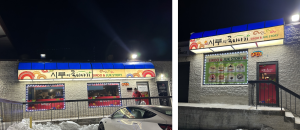
My family and I used the smaller entrance, which, aside from the bright sign, is humble, and we didn’t know what to expect.
Immediately upon opening the doors, I was taken aback. From the outside, I did not picture the expansive interior, starting with a large area filled with many tables and booths, and a market-style space in the back.
Walking over to the far side, we first stopped to observe the various Korean snacks available, such as crunchy chips, boxes of seaweed, curry paste, and bags of sweets. I later learned these treats to include the sweet and crispy Nongshim Chochung U-Gua rice cracker, the fruity candy Haitai, and rice cake desserts such as Injeolmi and Songpyeon.
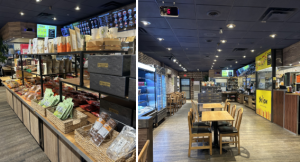
A yellow-bedecked stand sold classic Korean corn dogs and fries, such as a Potato Dog and Crispy Rice Dog.
Above the check-out counter were TV screens displaying their other menu items, the same menu that can be found on their website.
The name “Siroo” refers to the traditional Korean round bowl used to make the bread Dduk, a Korean delicacy. The other half of their name, “Juk,” comes from the word for oatmeal or porridge, often served as a comfort food or restorative dish.
Though frequently eaten at breakfast, Juk can be enjoyed at any time of the day. Siroo has over 20 options of this delicacy, ranging from Pumpkin and Red Bean to Spicy Kimchi and Spicy Bulgogi Octopus. My dad and I selected a Curry Chicken oatmeal to share.
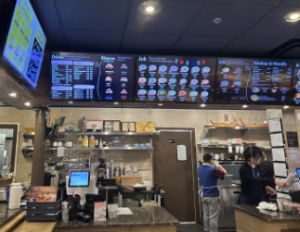
It is important to note that the restaurant has limited options for vegetarians, and those with allergies or dietary restrictions may wish to ask staff for a list of ingredients, as they are not outlined extensively in the menu.
My mom, who is a vegetarian (and an occasional pesketarian), chose a Tofu Bibimbap. My dad and I also ordered a Bibimbap –for us the Bulgogi— again to share. Because these two items are only available for dining in, we picked out a booth while we waited for our food.
We also asked one of the staff for an appetizer recommendation, and ended up grabbing some fish cakes. For someone who isn’t a fan of strong fish flavors, it was an unexpected surprise.
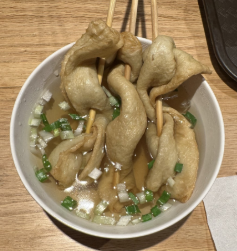
Fish cake is a popular Korean street food, served dipped in broth on skewers. It is typically made with surimi fish, flour, carrots, onion, and sugar; it is either boiled, fried, or steamed once kneaded into shape.
The fish was extremely soft, and combined with the warm broth, very comforting. It had slightly sweet notes that woke up my taste buds for the next course.
The structure of the restaurant is self-serve, leaning into the street-food experience. Customers order, find a seat, collect their food, and grab the necessary utensils.
A screen displayed the number 6 —the number we were given when ordering— and we headed to the back to receive the trays of hot food and carry them back to our table.
Each order came with generous servings, great for sharing or leftovers. In addition to the main orders, each tray comes with a variety of Korean condiments and small samples. This includes sauces, Kimchi, pickled vegetables, and fish noodles. Since the menu isn’t very descriptive, it is a bit of a surprise, and we trade ideas on what these unexpected treats might be.
Both Bibimbaps came with the same ingredients, except for tofu and pork, consisting of large bowls filled with rice, eggs, lettuce, cabbage, sesame seeds, carrots, bean sprouts, and more. As sides, the Bibimbap had cold kimchi, pickled vegetables, and soup.
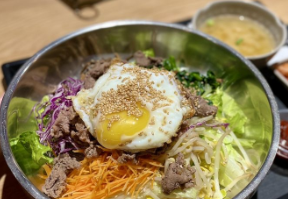
The most important element of the dish is the Gochujang, a sweet-savory red pepper paste sauce. It’s a little bit spicy, and necessary to enhance the flavor, especially for the tofu bowl, which lacks the taste contributed by meat.
The sauce was by far my favorite part of the meal, and by the end, we were scraping the bowl for any last drops.
I was curious to know whether Juk’s professed qualities of restoration would hold true, and the first bite convinced me it would. It’s super comforting, very hot, cheesy, and creamy. If someone needs warming on a rainy day or a pick-me-up during a cold, I highly recommend trying one of Siroo’s Juks.
The porridge came with kimchi as well, in addition to cold pulled pork and a type of fish coated in slightly sweet sauce.
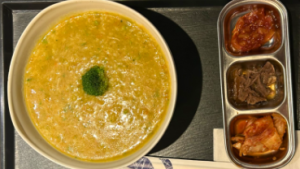
Given how many elements are in each dish and the enormity of the portion sizes, I was shocked by how fast our food was ready. Though, according to Liu, “It’s always very quick.”
The owners of the restaurant were successful in creating the desired street food and café experience. A TV playing K-pop dancing and subtle music in the background created an energetic yet calming atmosphere.
“The environment is always very relaxing,” said Liu.
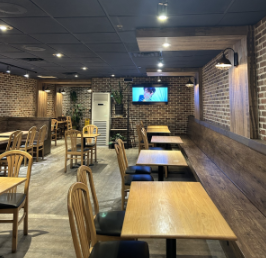
Prices are quite reasonable for such large portion sizes (the Juk bowl was wiped clean anyway), with porridges costing $10.99-$15.99, other menu items such as the Bibimbap and Ramen $9.99-$14.99, and the corn dogs and fries $3.99-$5.49.
It is important to note the other menu items that in our first visit we were unable to sample.
“I feel like the thing they’re most famous for is their shaved ice, which I particularly enjoyed,” reported Ma.
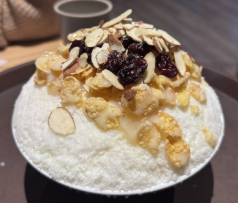
This frozen dessert is known in Korea as Bingsu. Costing $9.99-$12.99, one is big enough to share between multiple people, and though we found February too cold to enjoy this sweet treat, the large group seated next to us came just to sample the dessert. Flavors are Chocolate, Strawberry, Mango, and Red Bean.
“The Red Bean Bingsu is the best dessert,” asserted Liu.
In terms of main entrés, Christine said, “My favorite food item I’ve tried from there would be the Naengmyeon, which is like a cold noodle.” She continued, “[It] is very common in Korea, and it’s really refreshing, especially in the summer.”
“I also love their Tteokbokki.” She explained, “It tasted authentic.”
She’s referring to Korean rice cakes simmered in a sweet, spicy sauce.
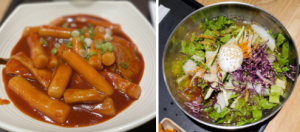
Other noteworthy menu items include Ramen, Beef Hotpot Bibimbap (Liu’s favorite), rice dishes like Spicy Octopus, and soups such as Red Bean Kalguksu. Next time, I am determined to be more adventurous and take advantage of their unique options.
Lastly, people can order from a long list of drinks. The Traditional Korean Teas Plum and Cinnamon Ginger caught my eye for future adventures.
In all, Siroo is a great pick for a large range of audiences.
“Whenever I go there, there are people of very different age groups, there are families, there are friends,” said Liu. “It’s very versatile, it fits in with everything.”
Meals like this remind me how lucky I am to live in such a diverse community. I barely have to leave my doorstep to walk into a whole world of new experiences.