
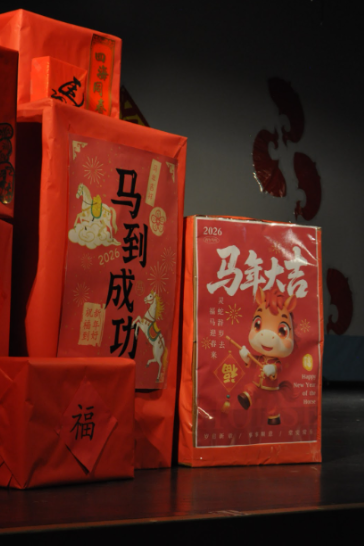
As I walk into Centennial High School, the first thing I notice is the vibrant burst of red plastered all around the cafeteria. The space has been transformed. Red Chinese couplets are posted on the walls and lying on the tables. Hanging from the ceiling are red lanterns. To my right and left hang the night’s menu, featuring a variety of Chinese dishes I cannot wait to try. Walking to observe the behind-the-scenes preparation for the performances occurring after dinner, I am mesmerized by the melodic movement of the flower dancers, yielding wavy, colorful fans. It is truly a vibrant setting.
Although the well-known American New Year’s Eve tune of Auld Lang Syne has faded following the welcoming of 2026, the New Year’s festivities are not over. On February 17, the Lunar New Year was welcomed all over the globe. It is a prominent holiday originating in East Asia, and perhaps one of the most well-recognized holidays in the world.
The Lunar New Year is a fifteen-day celebration, marking the arrival of spring and the beginning of a new year on the lunisolar calendar. There is a wide array of names used depending on the country celebrating, including the Spring Festival, Tết, and Seollal, in China, Vietnam, and Korea, respectively.
Here at Centennial, a festive celebration was put on by our very own National Chinese Honor Society, in collaboration with Meade High School, the Baltimore International Academy, and the Chinese Bridge Club in Maryland. These participations were not just to observe the festival, but to showcase the multicultural Centennial community the beauty of this unique celebration.
“For me personally, as a Chinese, this event is really important for people like me who want to learn more about our own culture,” Jamie Ye said, a senior member of Centennial’s Chinese Honor Society. “When it comes to an event like the New Year, which emphasizes unity, it’s really important to try to reach out to other people, to make new connections and strengthen old ones,” emphasizing the significance of not just hosting such an event, but hosting it in collaboration with other groups.
Regardless of the names, the Lunar New Year is marked universally by many vibrant traditions. Homes are decorated with red paper cuttings, red lanterns, and couplets symbolizing good luck and expressing their wishes for the new year, which offers the appealing promise of a fresh start. Most importantly, there is a large feast shared with family to kick off the festivities with a full heart and a full stomach.
“In years past, when China was poor, it was [a chance] to get real food, real new clothes,” Ye said. ”It is the most important holiday in Chinese culture.”
I can see how that is the case. On top of the aesthetic setting, there is so much engagement between people of all ages and ethnicities. Different activities set up around the cafeteria range from tai chi ball, involving keeping up a ball using a racket, to pitch pot, involving throwing arrows into a pitcher, and there is an abundance of laughter ringing from the smallest child to the oldest man.
The food was wonderful as well. With an abundance of options, such as Lo Mein, Kung Pao Chicken in a peanut and garlic sauce, Broccoli Beef, Dumplings, and Mapu Tofu, all guests ate to their fill. It was a delicious meal that reminded me again of the importance of the New Year’s feast.
One of the most meaningful moments of the night occurred at the calligraphy station. I watched as a Centennial student painted in long strokes the Chinese symbol for “love.” All of a sudden, an elementary-aged African-American boy walked up behind the Centennial student, tapped him on the shoulder, and politely asked if he could paint a word too. With a smile, the student handed the boy the brush. In one brilliant flash, the boy, in a beautiful, fluid, crisp motion, painted a different Chinese character in nearly perfect form.
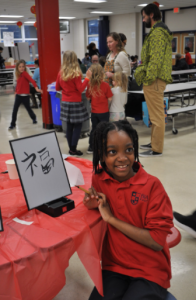
My jaw was not the only one on the floor. I erupted into a fit of delighted laughter, just as the student next to me did. He said something in Chinese to the boy, who then responded without a moment’s hesitation. I shook my head in awe. One of the volunteers who noticed my look of shock came up to me and explained that the little boy was from the Baltimore International Academy, a school in which they learn and study a language starting in Kindergarten.
It was a humbling, beautiful, and delicate moment of joy where two students of completely different ethnicities, backgrounds, and ages came together to share a brief moment of authentic connection—stemming from this one New Year’s tradition.
In the Chinese Zodiac, this is the year of the horse. The Zodiac follows a twelve-year cycle, each year represented by a different animal. The horse represents freedom, energy, and speed, highlighting a year focused on bold moves and exploration. Judging by these students’ vibrant celebration, it seems likely that the horse’s significance has already come to fruition.


